Major US–Israel Attack on Iran — Trump Calls on Citizens to Rise Up
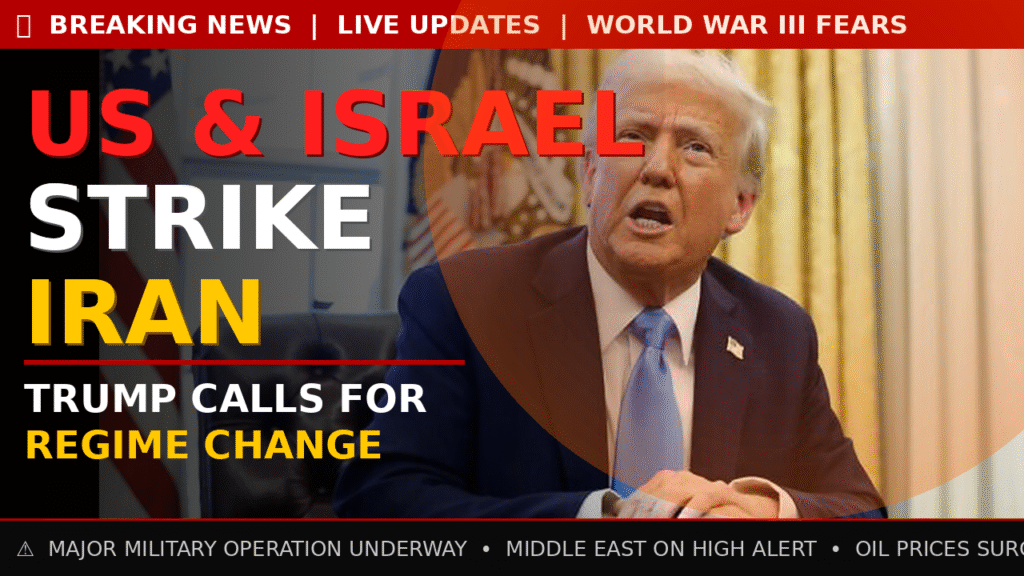
In one of the most dramatic and consequential military decisions of the 21st century, the United States and Israel launched a massive joint offensive against Iran on Saturday, February 28, 2026 — a day that may redefine the balance of power across the entire Middle East. President Donald Trump, speaking from behind a podium early Saturday morning in a video posted to Truth Social, announced the start of what he called “major combat operations” against Iran and, in an extraordinary call to action, urged the Iranian people to rise up and seize control of their own government.
The operation, codenamed “Operation Epic Fury” by the Pentagon and “Roaring Lion” by the Israeli Defense Forces, marks the second major US-Israeli strike on Iran in less than a year — and by far the larger of the two.
How It Started: The Final Breaking Point
The road to war was paved over months of failed diplomacy. For weeks before the strikes, US envoys Jared Kushner and Steve Witkoff had been conducting negotiations with Iranian officials over Tehran’s nuclear program. Those talks — mediated through Oman — had reportedly made “significant progress” just hours before the bombs fell, according to Oman’s Foreign Minister.
But the trigger came when Trump’s envoys concluded that Iran’s final counterproposal was, in one senior official’s words, “bullshit” — designed simply to buy Tehran more time rather than reach a genuine agreement. Trump, who had previously set a 10-day deadline for Iran to comply, made the call from Mar-a-Lago on Friday night. Operation Epic Fury began at 1:15 a.m. ET on Saturday.
The decision came after years of escalating tensions — and against a backdrop that left Iran in its most vulnerable position since the 1979 Islamic Revolution.
What Was Targeted: A Surgical Decapitation Strategy
The strikes were far from random. US and Israeli forces went after the heart of the Iranian regime’s military and political infrastructure.
Key targets included:
- IRGC (Islamic Revolutionary Guard Corps) command and control facilities
- Iranian air defense systems across multiple cities
- Ballistic missile and drone launch sites
- Military airfields throughout the country
- Iran’s main intelligence agency headquarters — with top commanders reportedly targeted
- Supreme Leader Ayatollah Ali Khamenei’s compound in Tehran, which satellite imagery shows was heavily damaged or destroyed
- Nuclear-related and military infrastructure in cities including Tehran, Isfahan, Qom, Karaj, and Kermanshah
US Central Command confirmed no American combat casualties in the initial hours of the operation, though Iranian missiles struck US military installations in Bahrain, Kuwait, Qatar, and other Gulf states in retaliation.
Trump’s Message: “Take Over Your Government”
In his eight-minute video address, Trump made a historic and bold appeal directly to the Iranian people — a message unlike anything a US president has ever publicly broadcast during an active military operation.
“When we are finished, take over your government. It will be yours to take. This will be, probably, your only chance for generations.”
Trump portrayed the offensive as both a security necessity and a liberation mission, calling the Iranian regime “a vicious group of very hard, terrible people” responsible for decades of regional terror. He told IRGC forces to lay down their arms in exchange for “complete immunity,” or face “certain death.”
His stated objectives were clear:
- Destroy Iran’s missile capabilities and military infrastructure
- Prevent Iran from ever obtaining a nuclear weapon
- Protect American troops and allies in the region
- Create the conditions for the Iranian people to overthrow the Islamic Republic
The Fate of Khamenei: A Nation Holding Its Breath
Perhaps the most shocking development of the day was the uncertainty surrounding Supreme Leader Ayatollah Ali Khamenei, 86 — the man who has ruled Iran since 1989.
Israeli Prime Minister Benjamin Netanyahu stated there were “many signs” the Supreme Leader was “no longer with us.” An Israeli official told Israeli media that Netanyahu was shown an image of Khamenei’s body recovered from his compound. However, Iran’s Foreign Ministry spokesperson insisted Khamenei was “safe and sound,” and that the country’s government “system is working.”
The fog of war made confirmation impossible in the first hours. What was undeniable was that Israel’s opening salvo delivered a direct strike on Khamenei’s compound in Tehran — a signal of the operation’s ultimate intent.
Iran Fights Back: A Regionwide Inferno
Iran’s retaliation was swift and geographically sweeping. Within hours of the first strikes, Iran launched an unprecedented wave of ballistic missiles and drones targeting:
| Target Location | Nature of Attack |
|---|---|
| Israel | Dozens of ballistic missiles fired; most intercepted |
| Bahrain | US military installations struck |
| Kuwait | US bases targeted |
| Qatar | Explosions reported near US facilities |
| Saudi Arabia | Iranian missile strikes |
| UAE | Blasts heard from Dubai beaches |
| Jordan | 49 drones and missiles downed by Jordanian forces |
| Iraq (near Baghdad) | Iraqi militia fighters killed in strikes |
Israel’s air defenses intercepted many of the incoming missiles, with Magen David Adom reporting 89 people lightly injured. The Houthis in Yemen also announced they would resume attacks in the Red Sea, threatening global shipping once more.
Political Fallout: A Nation Divided
The strikes triggered immediate and fierce political debate inside the United States.
Democrats were quick to condemn the action. Former Vice President Kamala Harris called it “Trump’s war of choice” and stated flatly: “I am opposed to a regime-change war in Iran, and our troops are being put in harm’s way.” Congressional Democrats argued the president had no authority to launch such an operation without approval from Congress.
The White House pushed back, with Press Secretary Karoline Leavitt confirming that Republican and Democratic congressional leaders had been briefed in advance, if not given a formal vote.
Even within Trump’s own base, some voices expressed unease. Several figures in the MAGA movement worried the strikes could draw the US into a prolonged Middle Eastern conflict — the very thing Trump had long promised to avoid.
The irony was not lost on observers: Trump had repeatedly and publicly mocked the idea of attacking Iran when Barack Obama was president, warning that any such move would be a sign of weakness or desperation. CNN’s analysis noted that Trump’s own polls had declined substantially in the past year — echoing the very scenarios he once used to taunt Obama.
The International Response
The global reaction was swift and largely critical.
The United Nations Security Council convened an emergency session hours after the strikes began. Iran called the attack “a clear crime against international peace and security” and a violation of the UN Charter.
Oman’s Foreign Minister, who had been mediating the nuclear talks, expressed dismay: “Active and serious negotiations have yet again been undermined. Neither the interests of the United States nor the cause of global peace are well served by this.”
Inside Iran itself, reactions were mixed — with some citizens celebrating in videos that circulated online, while others expressed panic and grief, particularly after reports emerged that a girls’ school in southern Iran had been struck, killing at least 57 to 85 students according to various reports. US Central Command said it was looking into the incident.
Reza Pahlavi, the son of Iran’s last Shah, urged Iranians to prepare for protests and called on the Iranian military to side with the people rather than the regime, describing the strikes as a “humanitarian intervention.”
What Comes Next? The Unanswered Questions
Military analysts and regional experts are raising urgent questions that neither Washington nor Jerusalem has fully answered.
| Key Question | Current Status |
|---|---|
| Is Khamenei dead? | Unconfirmed — conflicting reports |
| How long will the operation last? | “As long as needed” — Netanyahu |
| What government replaces the regime? | No plan articulated by US or Israel |
| Will Iran close the Strait of Hormuz? | Oil tankers already rerouting |
| Will US ground troops be deployed? | No indication yet |
| What is the nuclear fallout risk? | IAEA monitoring; Bushehr reactor status unclear |
The Strait of Hormuz — through which roughly 20% of the world’s oil supply passes — is already seeing disruption, with tankers turning around to avoid the war zone. Global oil markets opened sharply higher.
A Historic Turning Point
Whether Operation Epic Fury achieves its goals or spirals into a broader regional war, February 28, 2026 will be remembered as a turning point in Middle Eastern history. The Islamic Republic of Iran, which has wielded influence across the region through proxies, nuclear ambition, and ideological revolution for nearly half a century, now faces an existential challenge it has never encountered before.
Trump has cast the gamble of his presidency. The Iranian people stand at a crossroads. And the world watches — with hope, fear, and deep uncertainty — to see what comes next.
Frequently Asked Questions (FAQs)
Q1: What is “Operation Epic Fury”? Operation Epic Fury is the official Pentagon name for the joint US-Israeli military offensive against Iran that began on February 28, 2026. Israel called the same operation “Roaring Lion.” The operation targeted Iran’s missile infrastructure, air defense systems, intelligence agencies, and regime leadership.
Q2: Why did the US and Israel attack Iran now? The immediate trigger was the collapse of nuclear negotiations. Trump’s envoys determined that Iran’s latest proposal in ongoing nuclear talks was not made in good faith. After a 10-day ultimatum expired, Trump authorized the strikes. The broader context includes Iran’s weakened state following June 2025 strikes, the collapse of its proxy network, and renewed nuclear concerns.
Q3: Was Supreme Leader Khamenei killed? As of early reporting, Israeli officials claimed there were strong indications Khamenei was killed in a strike on his compound. Iran’s Foreign Ministry denied this, saying he was “safe and sound.” The situation remained unconfirmed amid conflicting reports.
Q4: Did Iran retaliate? Yes. Iran launched a large-scale retaliatory strike involving dozens of ballistic missiles and drones targeting Israel, US military bases in Gulf countries, and neighboring states including Saudi Arabia, UAE, Kuwait, Qatar, and Bahrain.
Q5: Was this attack legal under US law? This is disputed. Democrats in Congress argued Trump acted without proper congressional authorization, which is required under the War Powers Act for sustained military operations. The White House said congressional leaders were briefed in advance. Iran’s Foreign Minister called the strikes a violation of the UN Charter.
Q6: What is Trump’s end goal in Iran? Trump stated multiple objectives: eliminating Iran’s nuclear program, destroying its missile capabilities, and ultimately enabling the Iranian people to overthrow the Islamic Republic. However, neither the US nor Israel have presented a clear plan for what a post-regime Iran would look like.
Q7: Could this affect global oil prices? Yes. The Strait of Hormuz — a critical chokepoint for global oil — is already being avoided by tankers. Any disruption to this route could send oil prices significantly higher and impact economies worldwide.
Q8: How did the US public and allies react? Reactions were divided. Some allies expressed support, while others including the UN, Oman, and several European nations expressed alarm. Within the US, Democrats strongly condemned the strikes, while some members of Trump’s own base also expressed concern about another prolonged Middle East war.