The Hidden Network: How Elon Musk Built a Corporate Powerhouse in Texas
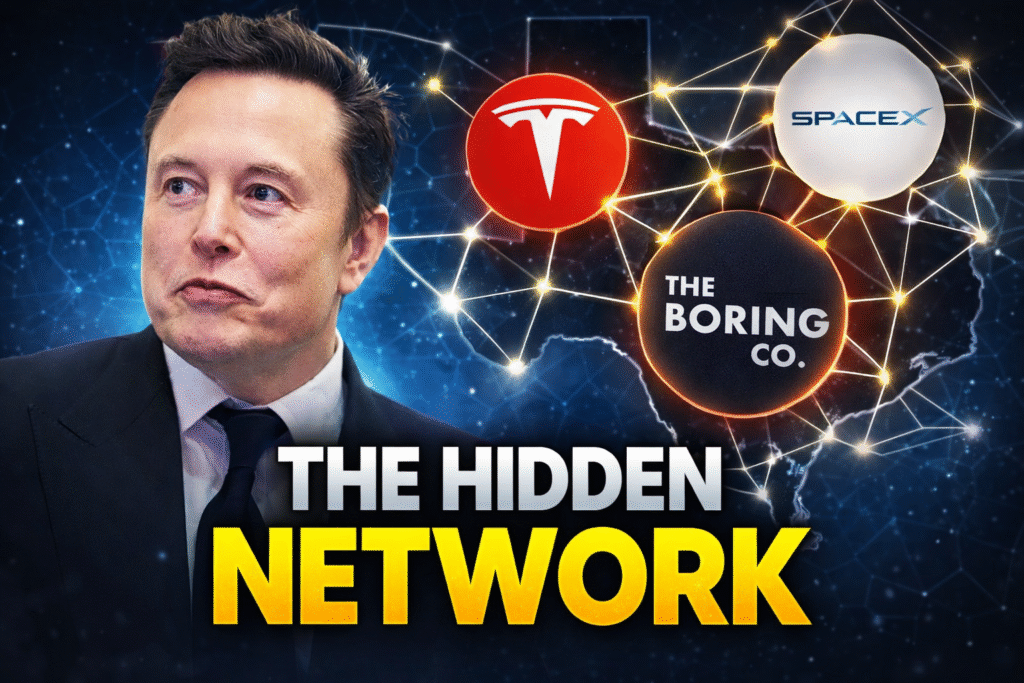
When most people think of Elon Musk, they picture rockets launching from Florida, electric cars rolling out of California factories, or late-night tweets shaking the stock market. But over the past few years, something massive has been quietly taking shape deep in the heart of Texas — a sprawling, interconnected empire of companies that the world’s wealthiest man has been building with a level of secrecy that would impress even the most seasoned corporate strategist.
Texas isn’t just a state Musk moved to for lower taxes. It has become the beating heart of his grand vision for the future — a vision that touches space exploration, artificial intelligence, tunneling, energy, and even the very nature of cities.
Let’s pull back the curtain.
Why Texas? The Move That Changed Everything
In 2020, Elon Musk made headlines when he announced he was leaving California and relocating to Texas. At the time, many dismissed it as a tax move — and yes, the absence of state income tax in Texas certainly didn’t hurt. But looking back, it’s clear the migration was strategic on a much deeper level.
Texas offered Musk something California couldn’t: space, speed, and political goodwill. In Texas, you can build a launchpad in a small coastal town with relatively little red tape. You can acquire land quietly. You can grow fast. And critically, local governments are often eager to welcome big employers with open arms.
What followed was not just a personal relocation, but a corporate one — multiple Musk-linked companies quietly began planting flags all across the Lone Star State.
SpaceX and Starbase: A Company Town in the Making
Perhaps the most dramatic example of Musk’s Texas ambitions is Starbase — a private company town being built near Boca Chica, a tiny beach community on the southern tip of Texas, just miles from the Mexican border.
SpaceX has been operating its Starship development and launch facility here since around 2019. But in 2021, Musk took it a step further by announcing plans to formally incorporate Starbase as its own city. Think about that for a moment — a billionaire building his own city around his rocket company.
The Starbase facility is where SpaceX tests and launches the Starship rocket, the most powerful launch vehicle ever built and the centerpiece of NASA’s plans to return humans to the Moon. Beyond that, it’s Musk’s chosen launchpad for his ultimate dream: colonizing Mars.
The land around Boca Chica has been largely bought up, residents have been bought out (some willingly, some not so willingly), and what was once a quiet beach town is transforming into something that looks more like a private spaceport nation-state. SpaceX employees live there, work there, and in many ways, depend entirely on the company for the functioning of their daily lives.
Tesla’s Gigafactory Texas: More Than Just Cars
In 2021, Tesla opened Gigafactory Texas, also known as “Gigafactory Austin” or simply “Giga Texas,” in the eastern outskirts of Austin. The facility is massive — over 10 million square feet, making it one of the largest buildings in the world by footprint.
This is where Tesla manufactures the Model Y for North American customers and is ramping up production of the highly anticipated Cybertruck. The factory employs tens of thousands of workers, and its presence has been a major economic driver for the Austin metro area.
But what makes Giga Texas interesting from a strategic perspective is its location within Musk’s broader Texas network. Austin is home to a growing tech ecosystem, a massive talent pool (thanks in part to the University of Texas), and a culture that has welcomed the influx of Silicon Valley transplants.
Tesla’s headquarters also officially relocated to Austin in 2021. The symbolism wasn’t lost on anyone — Musk was making it crystal clear that his center of gravity had shifted.
The Boring Company: Tunneling Under Texas
Not content with dominating the skies and the roads, Musk also wants to reshape what lies beneath our feet. The Boring Company, his infrastructure and tunneling startup, has made Texas a key part of its expansion plans.
The company, which began as something of a passion project to solve traffic congestion, has proposed tunnel networks in several Texas cities, including Austin. While many of these projects are still in early stages or navigating regulatory approvals, The Boring Company has its headquarters in Pflugerville, just outside Austin.
The company’s vision — moving people through underground electric vehicle tunnels at high speeds — is still finding its footing, but Texas’s sprawling, car-dependent urban landscape makes it a logical testing ground. If The Boring Company can make its model work anywhere, the wide-open suburban sprawl of Texas metros might be the place.
X Corp (Formerly Twitter): Austin Gets the Bird
After completing his controversial $44 billion acquisition of Twitter in late 2022, Musk wasted little time relocating the company’s headquarters. Twitter’s longtime home in San Francisco was shuttered, and X Corp — as the platform was rebranded — set up shop in Austin, Texas.
The move was both practical and pointed. Musk had been publicly critical of San Francisco’s governance and California’s regulatory environment for years. Relocating Twitter to Texas was, in many ways, a statement.
The Austin office has become the nerve center for one of the world’s most influential social media platforms, which Musk envisions transforming into an “everything app” — a super-platform combining social media, payments, news, and more, similar to WeChat in China.
xAI: Building Artificial Intelligence in the Lone Star State
In 2023, Musk launched xAI, his artificial intelligence company aimed at building what he calls a “maximally curious” AI — one that seeks to understand the universe rather than just optimizing for narrow tasks. The company is working on Grok, an AI chatbot integrated into X (formerly Twitter).
While xAI is headquartered in the San Francisco Bay Area for now, its deep integration with X Corp — which is Texas-based — means that Texas plays a significant operational role in the company’s day-to-day workings. As Musk consolidates more of his empire under one roof, xAI’s gravitational pull toward Texas seems likely to grow stronger.
Neuralink: Brain Chips and the Texas Connection
Neuralink, Musk’s brain-computer interface company, is working on implantable chips designed to help people with paralysis control computers and eventually expand human cognitive capabilities. While Neuralink is headquartered in Fremont, California, it has research and administrative operations in Texas, and Musk’s personal involvement keeps it closely tied to his Texas-centric network.
In 2024, Neuralink implanted its first chip in a human patient — a landmark moment that drew global attention. As the company scales, Texas’s growing life sciences sector could make it a more prominent player in Neuralink’s geographic footprint.
The Secret Sauce: How These Companies Feed Each Other
What makes Musk’s Texas web truly remarkable isn’t any single company — it’s the way they interconnect.
SpaceX’s Starlink satellites (launched from Texas) beam internet down to Tesla vehicles. Tesla’s energy storage products (Megapacks) help power facilities used by SpaceX. X Corp’s platform promotes and amplifies the brand stories of all the other companies. The Boring Company could theoretically tunnel transportation links between factory sites. And xAI could eventually power AI systems used across all of these businesses.
In effect, Musk is building an ecosystem — a self-reinforcing loop of companies that reduce each other’s costs, amplify each other’s reach, and collectively add up to something far greater than the sum of their parts.
It’s less a web of companies and more a vertically integrated civilization, one that Musk has been quietly assembling in Texas — mostly out of the public eye, while everyone was watching his tweets.
The Bigger Picture: What Does It All Mean?
Musk’s Texas empire raises big questions that don’t have easy answers.
Is it healthy for one person to control so much critical infrastructure — rockets, cars, tunnels, social media, AI, brain implants? What happens to the communities, like Boca Chica, that are reshaped or displaced by his ambitions? Who is accountable when a private city or a private AI system makes decisions that affect public life?
These are questions Texas — and the world — will need to grapple with as Musk’s influence continues to grow.
But whatever one thinks of the man, the scale of what he is building in Texas is genuinely historic. No private individual in modern times has assembled this kind of interconnected, multi-industry empire in a single state. It is audacious, it is controversial, and it is very, very real.
The Lone Star State may have been home to oil barons, cattle kings, and tech giants before. But it has never seen anything quite like this.